Cohort 01 · starts September 22, 2026
Bring an idea.
Leave with a product.
Three weeks, two evenings a week, after school. You'll build a real gadget, app or product — and demo it live on the last day.
Full refund until seven days before24 places
The build catalogue
Pick the thing you want to exist.
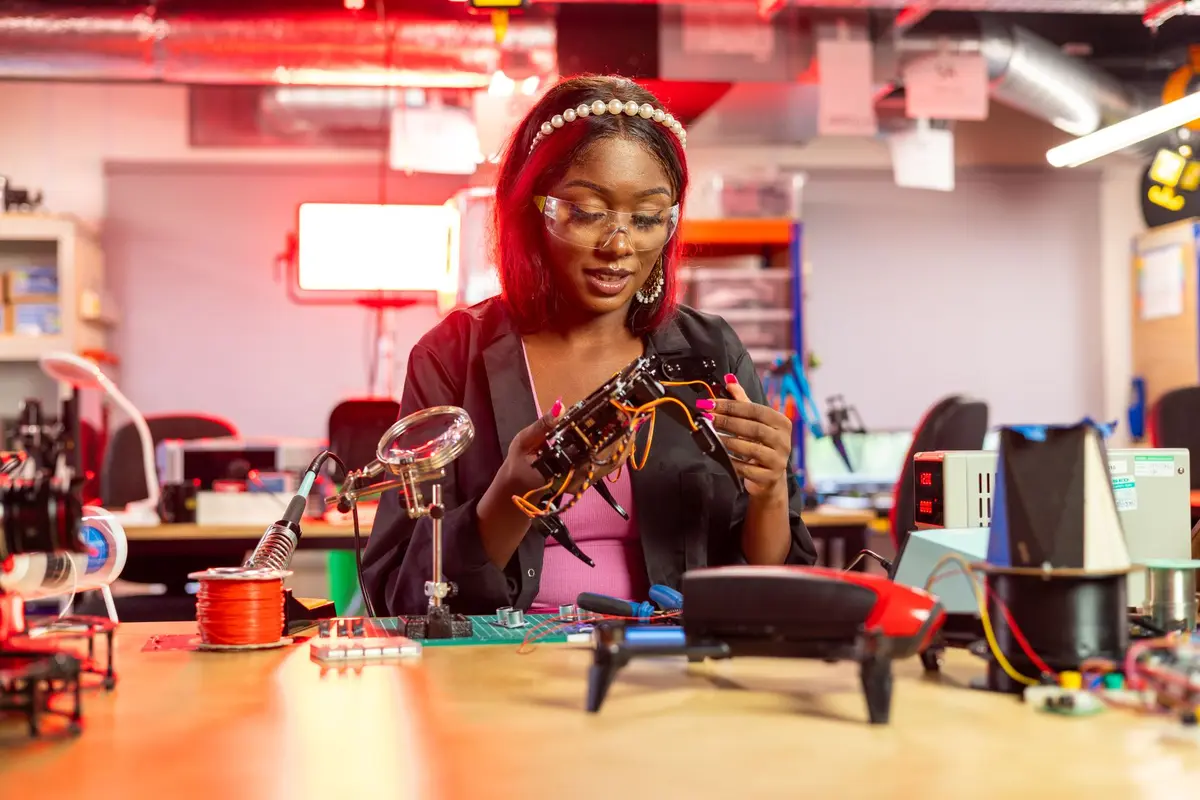
24 projects ready to go, each with its parts, its cost and its instructions. Click any card to see what you would end up with.


The deadline is the method.
Three weeks, three checkpoints. Each week ends with something that exists, and the instructor checks it in front of the group. Nothing gets carried forward on a promise.
Week 1
Foundation & Provisioning
What is worth building, and does your machine run?
CheckpointA provisioned workspace and a scored, written problem statement.
Week 2
Generative Build Sprint
Can the machine make the parts you need?
CheckpointA working core with generated media, code and copy inside it.
Week 3
Ship & Go To Market
Does it run in front of a stranger?
CheckpointA live MVP with a price, a landing page and its first users.
The tools you'll learn
The same tools professionals used this year.
Nothing here is a simplified classroom version that gets thrown away afterwards. These are the actual tools, and you keep the accounts.
- Claude
- GitHub
- Cloudflare
- ESP32
- Arduino
- Adafruit
- iPhone
- Android
- Stripe
- Python
- Figma
- ElevenLabs
What you'll actually be able to do.
Not a syllabus. This is the list of things a student cannot do on the first evening and can do on the last one.
- 01Take an idea in your head and say out loud, in one sentence, what it is and who it is for.
- 02Work out whether it is worth building at all, before spending three weeks on it.
- 03Set up a computer properly for building things, and not be frightened of the black window with the text in it.
- 04Get an AI to do the heavy lifting, then check its work instead of trusting it.
- 05Make your own images, voice, music and video, rather than downloading someone else's.
- 06Wire up a sensor and put your own program on a small device.
- 07Put an app on the internet at a real address that anyone can open.
- 08Make it work on a phone.
- 09Put a price on it and take a real payment.
- 10Set a spending cap so nothing you build can ever run up a bill.
- 11Show it to ten strangers, watch where they get stuck, and fix the top three.
- 12Stand up and demo the finished thing in five minutes without notes.
| Tool | What it is | What you'll be able to do |
|---|---|---|
| Claude | An AI you give instructions to in plain English. | Get an AI to write and fix code with you — and, more importantly, spot when it has got it wrong. |
| GitHub | Where the world's code is kept. | Save your work so it can never be lost, undo a bad day, and share a project by sending one link. |
| Cloudflare | One of the companies that runs the internet's plumbing. | Put your app on a real web address that loads fast anywhere in the world — for free, at the size you will be. |
| ESP32 | A computer the size of a stick of gum, costing a few dollars. | Wire up a sensor, load your own program onto it, and have a device that does something on its own. |
| Arduino | The friendliest way to program a small electronic device. | Read a sensor, drive a motor, light an LED, and understand what every line you wrote is doing. |
| Adafruit | The shop most makers buy their parts from. | Read a parts list, know what to order, and put together a bill of materials that adds up. |
| iPhone | The phone in most of your friends' pockets. | Make what you built work properly on a phone, so you can hand it to someone and let them try it. |
| Android | The other half of the phones in the world. | Do the same on Android, and know why the two are different. |
| Stripe | How most of the internet takes payments. | Put a price on the thing you made and take a real payment from a real person. |
| Python | The language most AI and data tools are written in. | Read code and change it, rather than only being able to ask an AI to rewrite it. |
| Figma | The tool designers use to draw apps before they are built. | Make your project look like a product somebody would pay for, rather than a school assignment. |
| ElevenLabs | AI that turns writing into a real-sounding voice. | Give your project a voice, and narrate the video you use to show it off. |
Product names and logos belong to their owners and are shown to identify the tools taught on this course. None of these companies sponsors, endorses or is affiliated with Comet Academy.
What should you build?
Answer three questions and we will suggest a real project, with what it costs and how long it takes. No sign-up, no email.
Deciding what to make is the hardest part of the first week. Doing it now means arriving with the decision already made.
$4,100 of value. $950 for a place.
The AI usage alone would cost more than the fee. The electronics kit arrives before the first class. Every recording stays yours.
Starts September 22, 2026 · 24 places
- 12 live classes over three weeks$2,000
- All the AI usage, paid for$1,000
- Every class recorded, yours to keep$400
- Twenty-four ready-made projects to choose from$300
- A one-to-one session with the instructor$250
- An electronics kit posted to your doorgadget projects only$150
- You pay$950

Who runs it
Jack Baum
Founder, General Intelligence Services
Jack Baum has spent his career moving real things: infrastructure projects between governments, goods across borders, commercial buildings in New York.
Now he builds the software that runs them. Station CRM, HardhatOS, Envkeep — shipped, in production, and public for anyone to read.
He is not a teacher who once built something. He builds every week, and this course is the method he uses.
In three weeks it gets you to the same place: a thing that exists.
In their words
No testimonials yet, because no one has finished yet.
Cohort 01 starts in September. When students finish, their words and their projects go here — and not before. Everything else on this site is written to the same standard: if it has not happened, it does not appear.
In three weeks it either exists, or it doesn't.
That is genuinely the whole idea. The deadline is what makes it happen.
24 places in Cohort 01.